
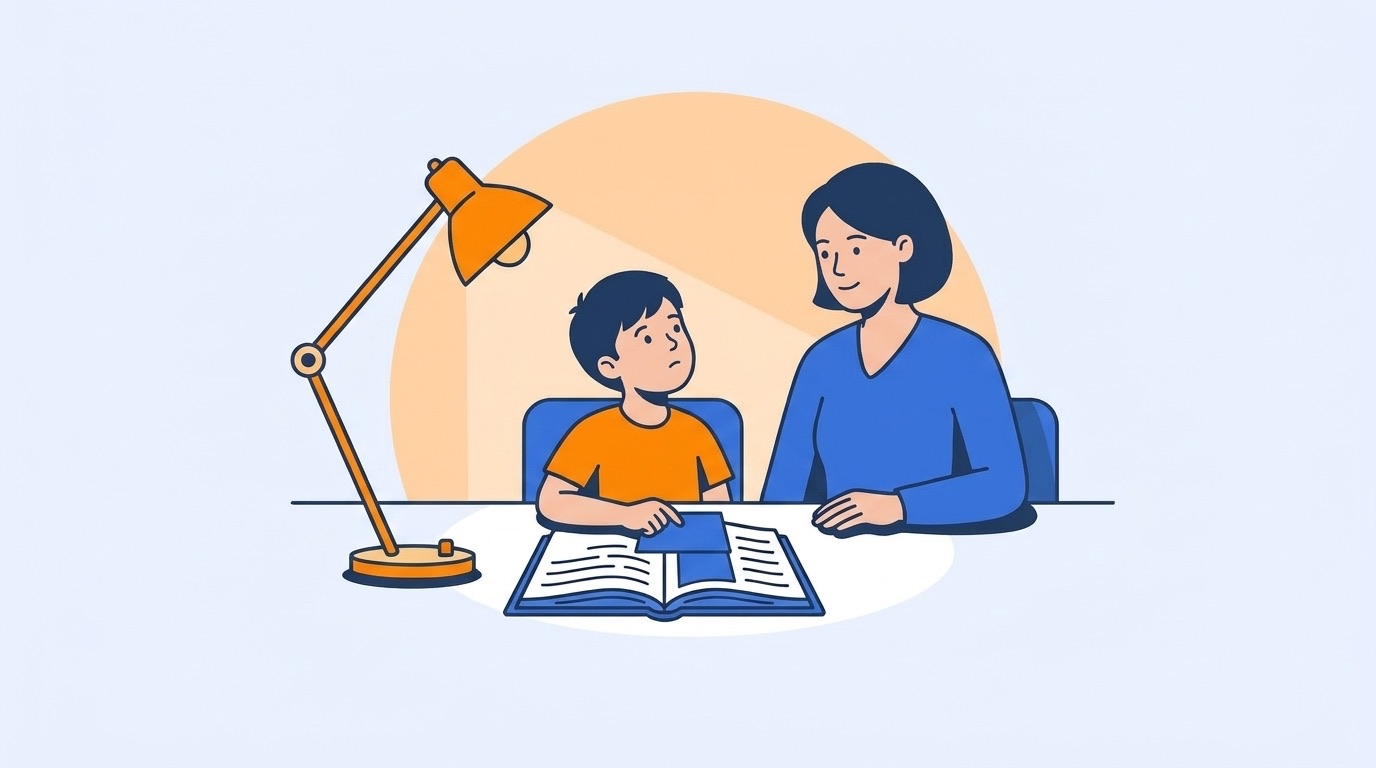
It's Thursday night. Your middle schooler reads the Spanish vocab list twice, closes the binder and says, "I've got it." Friday morning, the vocab quiz goes blank. If you're wondering how to learn vocabulary so it actually sticks, the answer starts here.
The problem isn't your child. It's the method. Rereading feels productive, but it trains the wrong skill.
Why rereading is the wrong way to study vocabulary
When your child rereads a list, the English is always right there next to the Spanish. The brain recognizes the word and assumes it knows it. Researchers call this the illusion of competence.
So you quiz them at the kitchen table and hint with the first letter. They get it, and you both relax. But nobody gives hints on the quiz. Recognizing a word and recalling it on your own are two different skills.
How to memorize vocabulary words: active recall
To learn vocabulary words for good, your child has to pull them from memory without help. That effort of recall is what makes a word stick. A wrong answer isn't a failure: it shows exactly what needs more practice.
Are flashcards active recall? Only if your child answers before flipping the card. Here's how to use flashcards effectively:
- Say the answer out loud first, then flip. No peeking, no "I knew that."
- Practice both directions: Spanish to English, then English to Spanish.
- Shuffle the deck, or your child just remembers the order.
- Never give the first letter as a hint.
- Pull out the missed cards and review them the next day and again a few days later.
Ten minutes of vocabulary practice a day beats an hour the night before. It's also how to memorize Spanish vocabulary fast: no time wasted on words your child already knows.
A vocabulary app that does the quizzing
Tired of making flashcards by hand? With VocaScan, your child snaps a photo of the vocab page in their textbook. The app recognizes the word pairs and builds a quiz in both directions, with no typing. Weak words get their own quiz, and if you enter the quiz date, reminders arrive 7, 3 and 1 day before.
Flashcards, without the flashcards
Snap the textbook page: VocaScan builds a two-way quiz and helps your child review the weak words before Friday.
Download on the App Store